grammy@cjm.com.cn

 English
 русский
 Español
 عربى
عربى
Content
- 1 What an ACP Production Line Produces and Why Demand Is Strong
- 2 Advantage One: High and Consistent Production Output
- 3 Advantage Two: Automated Process Control and Consistent Quality
- 4 Advantage Three: Low Material Waste and High Raw Material Efficiency
- 5 Advantage Four: Wide Product Range from a Single Line
- 6 Advantage Five: Low Labor Cost Per Square Meter of Output
- 7 Advantage Six: Energy Efficiency and Sustainability Positioning
- 8 Advantage Seven: Short Investment Payback Period
- 9 Advantage Eight: Scalability and Technology Upgrade Path
- 10 How to Evaluate an ACP Production Line Investment
- 11 Summary: ACP Production Line Advantages at a Glance
An ACP production line offers a compelling set of manufacturing advantages that make it one of the most cost-effective and versatile investments in the architectural panel and building materials industry. The core advantages are continuous high-speed output, consistent product quality through automated process control, low material waste, wide product customization capability, and a short payback period relative to the revenue potential of ACP products. Manufacturers who invest in a modern ACP production line gain the ability to serve construction, signage, interior decoration, and transportation markets simultaneously from a single production platform — with panel specifications, surface finishes, and core materials adjusted on the line rather than requiring separate equipment for each product variant.
What an ACP Production Line Produces and Why Demand Is Strong
Aluminum Composite Panel (ACP) is a sandwich material consisting of two aluminum skin sheets bonded to a thermoplastic polyethylene (PE) or fire-retardant mineral-filled core. The resulting panel combines the light weight and formability of aluminum with the rigidity and flatness of a composite structure — properties that no single material achieves on its own at comparable cost.
ACP has become the dominant cladding material for commercial building facades, retail signage, interior wall cladding, and transport interior panels worldwide. The global ACP market was valued at USD 5.9 billion in 2022 and is projected to reach USD 9.4 billion by 2031, growing at a compound annual growth rate (CAGR) of approximately 5.3%. This sustained demand growth is driven by urbanization in emerging economies, ongoing renovation of existing commercial buildings in developed markets, and the material's expanding adoption in transportation, advertising, and clean room applications. (Source: Allied Market Research, Aluminum Composite Panel Market, Global Opportunity Analysis, 2023)
For a manufacturer operating a dedicated ACP production line, this demand trajectory represents a durable and growing market with strong price realization — particularly for panels with premium surface finishes, certified fire-retardant cores, and tight dimensional tolerances that commodity importers cannot reliably supply.
Advantage One: High and Consistent Production Output
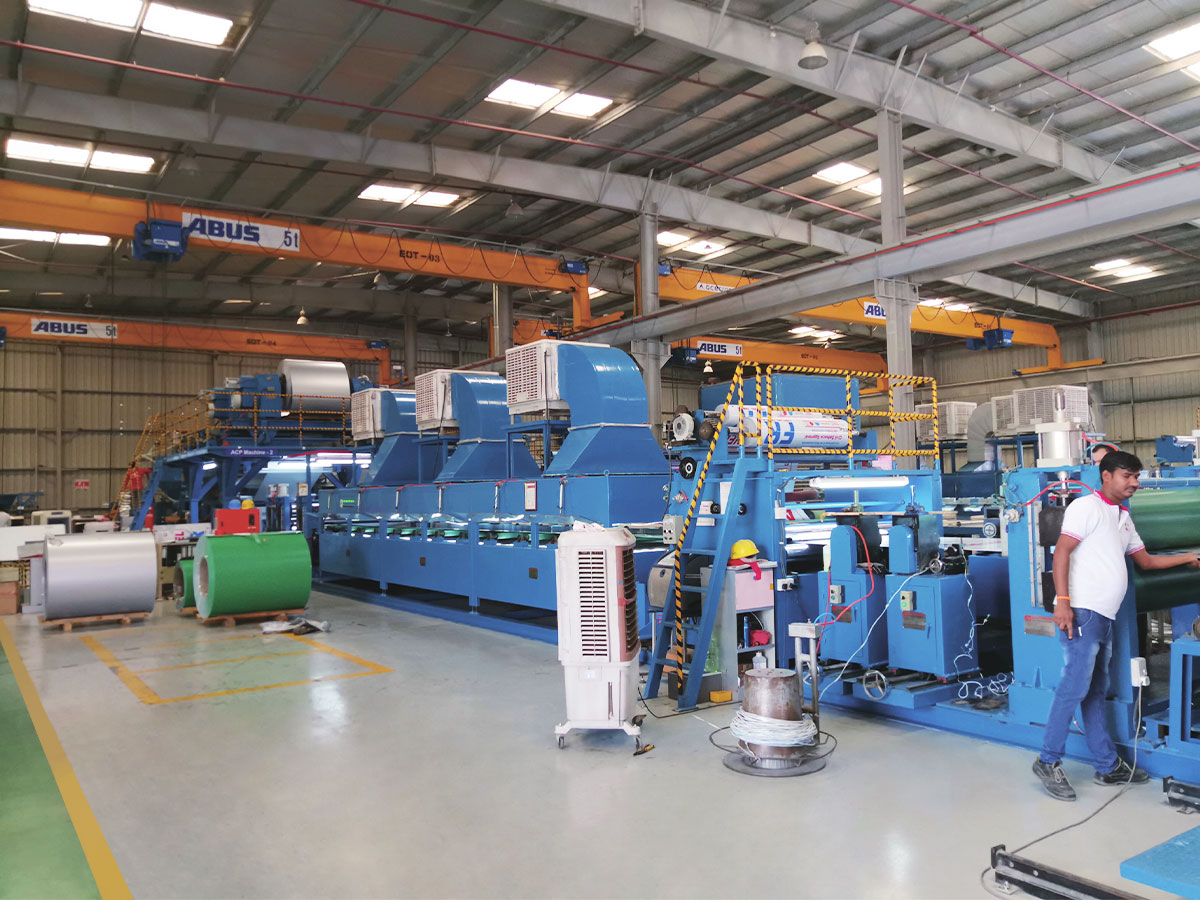
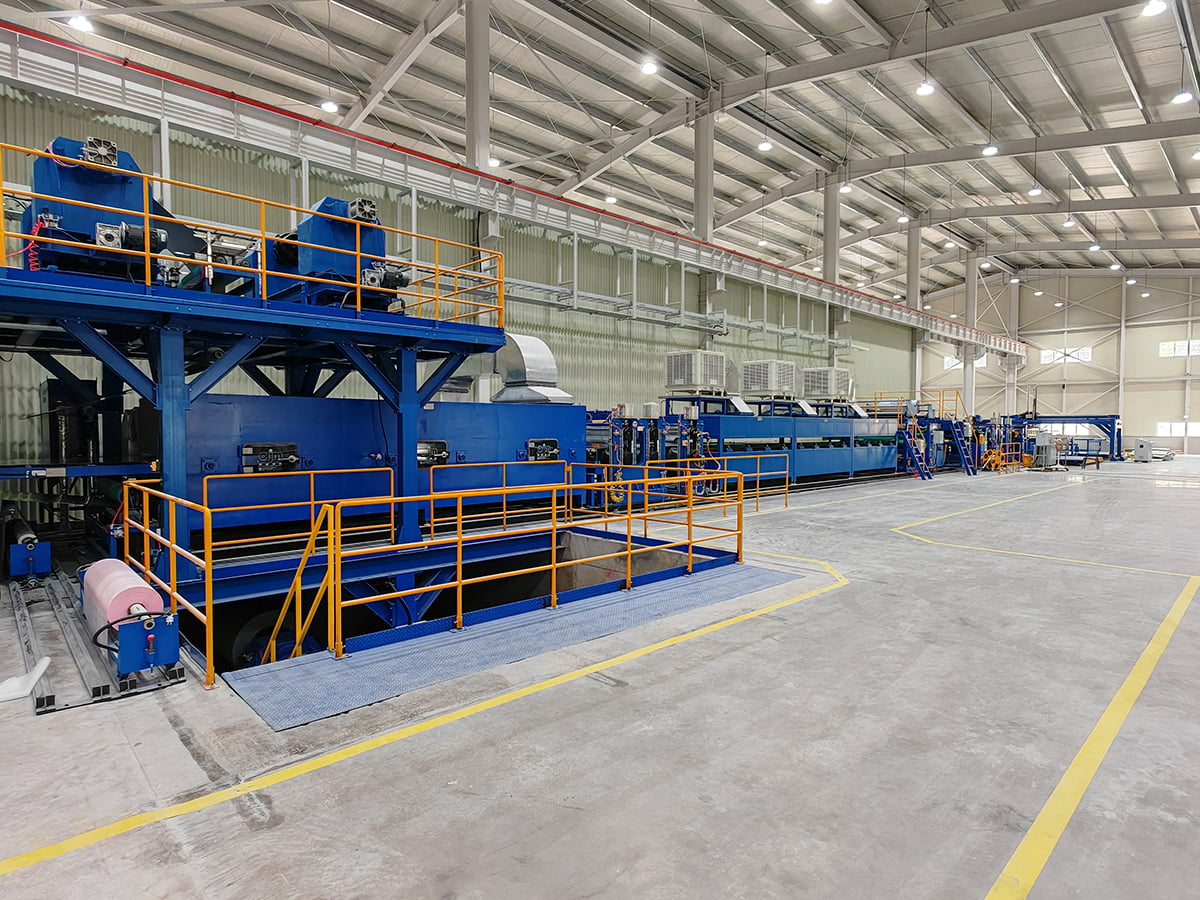
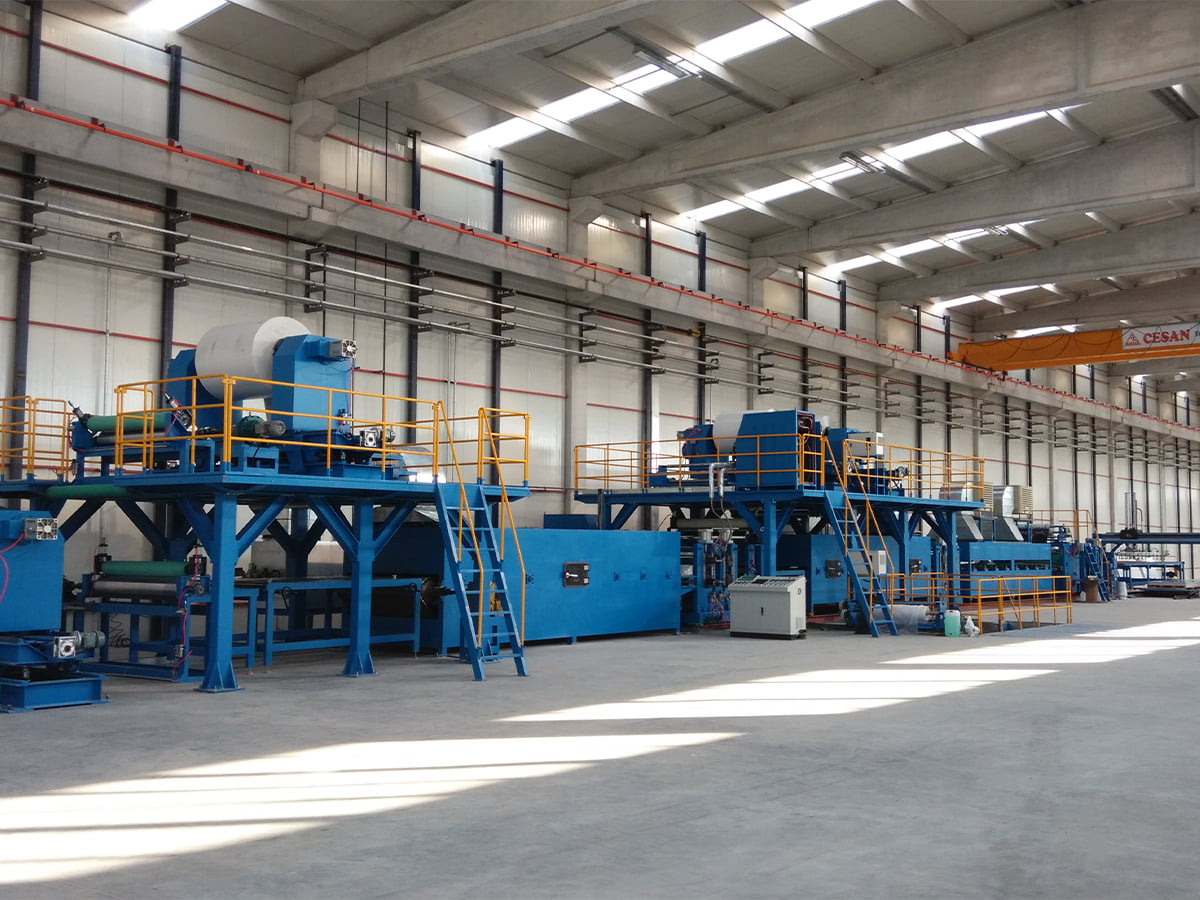
A fully integrated ACP production line operates as a continuous process from aluminum coil unwinding through lamination, coating or pre-painted surface application, and panel cutting — without the batch processing stops that characterize older manufacturing methods. This continuous design is the primary source of the line's output advantage.
Production Speed Capability
Modern ACP production lines operate at lamination speeds of 8 to 25 meters per minute depending on panel thickness and core specification. At a typical production speed of 15 meters per minute for standard 4 mm panel, a single shift of 8 hours produces approximately 7,200 linear meters of panel before cutting allowance. At a standard 1,220 mm panel width, this equates to more than 8,700 square meters of finished panel per single shift — sufficient to clad a medium-scale commercial building facade in one production run.
This output rate compares favorably with batch pressing or manual lamination processes, which typically produce 50 to 200 square meters per shift per operator depending on panel size and cure time. The continuous line eliminates press loading and unloading cycles, adhesive cure waiting times, and the quality variability associated with manual positioning of skin sheets during lamination.
Shift Flexibility and Annual Capacity
Because the continuous production process does not require long setup or cure cycles between panels, ACP production lines can shift between single-shift, double-shift, and continuous three-shift operation without significant retooling time. A line running two shifts per day at 15 m/min produces approximately 4.5 to 6 million square meters per year — well within the demand base of a regional distribution market. This shift flexibility allows the manufacturer to scale production up or down with market demand without incurring the fixed costs associated with idle batch equipment.
Advantage Two: Automated Process Control and Consistent Quality
The most significant quality advantage of a modern ACP production line over manual or semi-automated production methods is the elimination of operator-dependent variability from the critical process parameters that determine panel quality.
Critical Parameters Under Automatic Control
- Lamination temperature and pressure: The bonding of aluminum skins to the PE or mineral core requires precise temperature control at the bonding rolls — typically 180 to 220 degrees Celsius with variation of less than plus or minus 2 degrees Celsius across the full panel width. PLC-controlled heating systems maintain this temperature profile continuously, eliminating the bond strength variability that characterizes batch pressing where different areas of the panel may experience different temperatures during the press cycle
- Line speed control: Consistent line speed ensures uniform adhesion dwell time between the aluminum skins and the core as they pass through the lamination nip. Servo-driven line speed control maintains speed consistency to within 0.1% of setpoint, preventing the bond voids and delamination risk that result from speed fluctuations in manually controlled production
- Tension control on aluminum coil unwinding: Consistent tension in the aluminum skin as it enters the lamination zone prevents waviness, stretch marks, and surface oil-can distortion in the finished panel. Automatic dancer-controlled unwind tension systems maintain consistent web tension from full coil to paper-end across the full coil diameter change
- Panel thickness control: Automated thickness measurement using laser or contact gauges at the exit of the lamination section enables real-time feedback to the bonding roll gap, maintaining finished panel thickness to within plus or minus 0.1 mm of nominal specification throughout the production run
- Cutting length accuracy: Servo-driven flying shear or rotary cutting systems cut panels to the specified length with accuracy of plus or minus 0.5 mm per linear meter, eliminating the length variation of manual or stop-start cutting that requires allowance cutting and increases waste
Quality Consistency as a Market Advantage
Consistent automated quality control translates directly into commercial advantages: lower customer complaint rates, reduced warranty costs, and qualification for supply to large construction projects that require panel certification to ISO 10169, EN 1396, or ASTM E84 standards. These certifications are difficult or impossible to maintain on manually controlled production and represent a significant barrier to entry that protects the market position of manufacturers operating certified automated lines.
Research by the American Society of Quality found that manufacturers using automated statistical process control (SPC) in continuous production lines reduce defect rates by 40 to 60% compared to equivalent batch production without automated monitoring, while simultaneously reducing inspection labor costs by 25 to 35%. (Source: ASQ Quality Progress Journal, Automated SPC in Continuous Manufacturing, Vol. 49, 2016)
Advantage Three: Low Material Waste and High Raw Material Efficiency
Material waste is one of the largest controllable cost factors in ACP manufacturing, because aluminum and PE core represent the majority of the bill of materials cost per square meter of finished panel. The continuous process architecture of an ACP production line minimizes waste at every stage:
- Coil-to-coil jointing without stopping the line: Automatic coil joining systems — flying splice or accumulator-buffered joint — allow new aluminum coil to be joined to the running tail without stopping the line. This eliminates the startup scrap associated with each stop-start cycle, where the first and last meters of each run may be off-specification while process conditions stabilize. A line with flying splice capability reduces startup scrap to near zero between coil changes
- Flying shear cutting to exact order length: By cutting finished panels to exact order lengths in sequence rather than to a standard length and subsequently trimming, an optimized cutting schedule reduces end-cut waste to less than 0.5% of total linear output on a well-programmed cutting optimizer
- Edge trim recovery: Aluminum edge trim from the slitting operation is collected and sold back to aluminum scrap markets at a high recovery value — typically 90 to 95% of the aluminum raw material cost — making edge trim effectively a zero-cost production item rather than a waste disposal cost
- Core extrusion integration: Lines with integrated PE core extrusion — where the core is extruded directly into the lamination process rather than supplied as pre-made sheet — eliminate the waste and handling cost associated with pre-cut core sheet and allow core thickness to be adjusted continuously without material changeover waste
The combined effect of these waste reduction measures is a material yield of 96 to 98% of raw material input into saleable panel output on a well-optimized continuous ACP production line — compared to yields of 85 to 92% typical of batch pressing operations where startup, trim, and process variation waste accumulates more significantly. (Source: Composites Manufacturing Magazine, Yield Optimization in Continuous Lamination Processes, Issue 4, 2019)
Advantage Four: Wide Product Range from a Single Line
One of the most commercially significant advantages of a modern ACP production line is its ability to produce a wide range of panel specifications — varying surface finish, core type, aluminum thickness, panel width, and total panel thickness — from the same equipment platform with minimal changeover time and cost. This product flexibility allows the manufacturer to serve multiple market segments simultaneously and respond rapidly to changes in demand without capital investment in dedicated equipment for each product variant.
Surface Finish Flexibility
An ACP production line can process pre-painted aluminum coil in any color and finish — PVDF coated, polyester coated, brushed, mirror-finish, anodized, woodgrain printed, stone-effect printed, and metallic — without any change to the lamination equipment. Because the surface finish is applied to the aluminum coil upstream of the production line (either by the coil supplier or by an integrated coil coating line), the ACP line sees only the aluminum skin thickness and surface coating weight as variables — both of which fall within standard processing parameters. This means a single production line can produce hundreds of distinct panel colorways and finishes without mechanical changeover.
Core Material Switching
Modern ACP lines accommodate multiple core types:
| Core Type | Application | Key Property | Market Segment |
|---|---|---|---|
| Standard PE core | Interior cladding, signage, non-fire-rated facades | Low cost, lightweight, flexible | General construction, advertising |
| Fire-retardant (FR) mineral core | Exterior facades on buildings over 18 m height | Passes A2 or B classification tests | High-rise construction, regulated markets |
| FR polyethylene core | Low-to-mid-rise facades, semi-regulated applications | B1 or B2 fire classification | Commercial and residential construction |
| Aluminum honeycomb core | Transport interiors, high-stiffness applications | Very high stiffness-to-weight ratio | Aerospace, rail, marine interiors |
Switching between PE and FR mineral core requires adjustment of lamination temperature and bonding pressure — changes that are executed through the control system in less than 15 minutes on a modern line — rather than equipment replacement. This capability allows the manufacturer to supply both standard-specification and fire-rated panels from the same line, addressing the full market spectrum without dedicated equipment for each grade.
Thickness and Width Range
A standard ACP production line can produce panels in the thickness range of 2 mm to 6 mm and widths from 1,000 mm to 1,600 mm through roll gap adjustment and slitting width setting — all without tooling changes. Length is cut to any dimension within the line's length encoder range, typically from 1,000 mm to 6,000 mm per panel. This dimensional flexibility allows the manufacturer to supply non-standard panel sizes for specific project requirements, which commands premium pricing compared to standard commodity sizes.
Advantage Five: Low Labor Cost Per Square Meter of Output
Continuous automated ACP production lines require far fewer operators per unit of output than batch or manual production methods. A fully equipped ACP production line producing at 15 m/min typically requires 4 to 6 operators per shift across all line positions — coil loading, quality monitoring, panel stacking, and packing — to produce over 8,000 square meters of finished panel. This equates to a labor input of approximately 0.0005 to 0.0008 operator-hours per square meter of finished panel.
By comparison, a batch lamination process producing the same panel specification requires manual positioning, pressing, cure time supervision, and unloading — a labor input of 0.005 to 0.015 operator-hours per square meter, an order of magnitude higher per unit of output. This labor efficiency advantage compounds across all overhead costs allocated per labor hour, including benefits, supervision, and facilities — making the continuous ACP line substantially more cost-competitive per unit of output even when the initial capital cost is higher than batch equipment.
Advantage Six: Energy Efficiency and Sustainability Positioning
Modern ACP production lines incorporate energy recovery and efficiency features that reduce the energy cost per square meter of output compared to older equipment generations and batch processes:
- Heat recovery from lamination rolls: The thermal energy in the lamination roll system is recovered and recirculated through the heating circuit rather than vented as waste heat, reducing energy input per meter of panel by 15 to 25% compared to non-recovery systems
- Variable speed drives on all major motors: Servo-driven rolls, fans, and pumps consume energy proportional to actual demand rather than running at full power continuously, reducing standby and low-load energy consumption by 20 to 35% compared to fixed-speed drive systems. (Source: International Energy Agency, Motor Systems Efficiency Supply Curves, IEA Energy Technology Perspectives, 2021)
- Reduced chemical consumption: Automated adhesive application systems apply bonding agent at precisely controlled coat weights — typically 8 to 12 grams per square meter — without the over-application that characterizes manual roller coating, reducing adhesive material cost and VOC emissions per unit of output
- Recyclability of aluminum trim and offcuts: The high aluminum content of ACP — typically 45 to 55% by weight for standard 4 mm panel — means that end-of-life ACP panels and production trim are recoverable as high-value aluminum scrap, supporting circular economy positioning that increasingly influences procurement decisions in construction markets with ESG requirements
Advantage Seven: Short Investment Payback Period
The combination of high output, low labor cost per unit, high material yield, and strong ACP market demand creates a financial return profile that supports short investment payback periods — typically 2 to 4 years for a well-located and well-marketed ACP production operation, depending on the local market price level and capacity utilization achieved.
Indicative Economics of ACP Production
| Parameter | Indicative Value | Notes |
|---|---|---|
| Line speed (standard 4 mm PE panel) | 15 m/min | Single-shift equivalent |
| Output per shift (8 hours) | Approx. 8,700 sq m | At 1,220 mm panel width |
| Annual output (2-shift, 250 days) | Approx. 4.35 million sq m | At 70% effective utilization |
| Typical market price range (standard PE ACP) | USD 4 to USD 12 per sq m | Varies by region, finish, and specification |
| Operators required per shift | 4 to 6 | Full line including packing |
| Material yield | 96 to 98% | Continuous lamination with flying splice |
| Typical payback period | 2 to 4 years | Market and location dependent |
These economics improve further as the manufacturer moves up the product value chain — producing fire-rated panels, custom PVDF finishes, or certified panels for regulated construction markets — where market prices of USD 15 to USD 40 per square meter are achievable for premium specifications. (Source: Global Construction Materials Pricing Report, Construction Industry Research Institute, 2022)
Advantage Eight: Scalability and Technology Upgrade Path
A modular ACP production line provides a scalable manufacturing platform that grows with the business rather than requiring replacement when demand increases:
- Speed upgrades: Most production lines can be upgraded to higher lamination speeds — within the mechanical design limits of the equipment — by upgrading the drive system and heating capacity without replacing the structural line components
- Width extensions: Lines designed with modular width capability can be extended from 1,250 mm to 1,600 mm or wider by replacing the lamination rolls and slitting knives, opening new product markets without full line replacement
- Automation upgrades: Manual packing and stacking stations can be upgraded to robotic automation as labor costs increase or throughput demands grow, with minimal disruption to the existing production flow
- Control system modernization: PLC and SCADA control systems are upgradeable independently of the mechanical line, allowing manufacturers to take advantage of Industry 4.0 data connectivity, predictive maintenance, and remote monitoring without replacing working mechanical components
This upgrade path means that the initial capital investment in an ACP production line is protected over a longer service life than equipment that becomes technically obsolete as market requirements evolve — an important consideration when evaluating the total cost of ownership over a 15 to 20 year equipment life.
How to Evaluate an ACP Production Line Investment
When assessing a specific ACP production line investment, evaluate these criteria systematically to ensure the equipment matches your market and production requirements:
- Target product specification range: Confirm the line can produce your full target panel thickness range, core type range, and panel width without significant tooling cost per changeover
- Lamination temperature uniformity: Request data on heating roll temperature uniformity across the full panel width — the critical parameter for consistent bond strength. Variation above plus or minus 3 degrees Celsius across width is a risk factor for edge delamination
- Control system capability: Confirm that the PLC system records and stores all critical process parameters per production batch for quality traceability — a requirement for certification to ISO and EN standards
- Cutting system accuracy: Verify the flying shear or rotary cut system accuracy specification and the minimum and maximum cut lengths relative to your order profile
- Coil joining system: Confirm whether the line includes flying splice or accumulator-based coil joining — a significant factor in effective yield, particularly on coil sizes below 5 tonnes where coil changes are frequent
- After-sales support and spare parts availability: An ACP production line is a long-term asset whose total cost of ownership is heavily influenced by equipment uptime. Confirm spare parts availability, service response time, and remote diagnostic capability before purchasing
The Metal Composite Panel Production Line from metalcompositepanelline.com is engineered to deliver the full set of advantages described in this article — high continuous output speed, precise automated lamination control, wide product range capability, and a modular design that supports future capacity and width upgrades. It is designed for manufacturers entering the ACP market or expanding existing capacity, with the technical specification depth and after-sales support needed to achieve rapid ramp-up to full production and consistent quality certification compliance.
Summary: ACP Production Line Advantages at a Glance
| Advantage | Key Metric or Outcome |
|---|---|
| High production output | 8,000 to 10,000 sq m per shift at standard speed |
| Consistent quality through automation | 40 to 60% defect reduction vs. batch production |
| Low material waste | 96 to 98% material yield on continuous lines |
| Wide product range | 2 to 6 mm thickness; PE, FR, honeycomb core; unlimited surface finishes |
| Low labor cost per unit | 4 to 6 operators per shift for 8,000+ sq m output |
| Energy efficiency | 15 to 35% energy reduction vs. older equipment through VSD and heat recovery |
| Short investment payback | 2 to 4 years at standard market pricing and utilization |
| Scalability | Modular upgrades for speed, width, and automation without line replacement |
| Market growth alignment | Global ACP market CAGR of 5.3% to 2031 supports sustained demand |
The conclusion: a modern ACP production line delivers a combination of production volume, quality consistency, product flexibility, and economic return that no manual or batch production method can match. For manufacturers targeting the growing global ACP market, it is the foundational capital investment that determines the competitiveness, quality positioning, and profitability of the entire business — making the selection of the right line and the right supplier one of the most consequential procurement decisions in the operation.