grammy@cjm.com.cn

 English
 русский
 Español
 عربى
عربى
Content
- 1 Overview: The Continuous Coil Coating Concept
- 2 Stage 1: Entry Section — Uncoiling, Joining, and Feed Preparation
- 3 Stage 2: Chemical Pre-Treatment Section
- 4 Stage 3: Primer Application and Curing
- 5 Stage 4: Topcoat Application and Curing
- 6 Stage 5: Backcoat Application (Where Required)
- 7 Stage 6: Exit Section — Accumulator, Inspection, and Recoiling
- 8 Common Coating Systems Processed on Metal Coil Coating Lines
- 9 Quality Control Checkpoints Throughout the Process
- 10 Process Flow Summary: From Bare Coil to Finished Pre-Painted Product
- 11 Selecting the Right Metal Coil Coating Line Configuration
A metal coil coating line processes bare metal coil through a precisely sequenced series of stages: uncoiling and joining, entry accumulator buffering, chemical pre-treatment, primer application and curing, topcoat application and curing, optional backcoat application, cooling and quenching, and exit accumulator followed by recoiling or cut-to-length. This continuous process — running at line speeds typically between 40 and 150 metres per minute depending on coating type and substrate — applies organic coatings to flat-rolled metal strip in a single, highly automated pass. The resulting pre-painted coil is then shipped to downstream manufacturers for forming into finished products such as building panels, appliance housings, automotive components, and packaging, without any further surface finishing required. Understanding each stage of the process flow in detail is essential for evaluating line design, troubleshooting coating defects, specifying process parameters for new coating systems, and selecting the right Metal Coil Coating Line configuration for a given production requirement.
Overview: The Continuous Coil Coating Concept
Coil coating — also called continuous strip coating or pre-painted metal production — is fundamentally a roll-to-roll manufacturing process in which metal strip is uncoiled at the entry end, processed continuously through a sequence of treatment and coating stations, and recoiled at the exit end. The key engineering achievement of the process is maintaining continuous strip movement through the entire line without stopping, even when an entry coil runs out or an exit coil must be changed.
This is achieved through accumulator sections — large loop towers or spiral accumulators that store a buffer of strip — positioned at both the entry and exit ends of the processing section. The accumulating strip buffer allows the entry and exit sections to stop briefly for coil joining or changing while the process section continues to run at full speed, maintaining coating quality and process stability.
Modern coil coating lines are designed around the principle that coating quality is far more consistent and controllable when applied to flat strip on a high-speed continuous line than when applied to formed parts individually. This is why coil-coated metal is used in preference to post-painting in virtually all high-volume applications where the finished product geometry can be formed from pre-painted strip.
Key Process Parameters
The entire process flow is governed by a small number of master parameters that cascade through all downstream variables:
- Line speed: Typically 40 to 150 m/min for standard organic coating applications; higher speeds require shorter oven dwell times and are therefore preferred for thinner coatings on lighter substrates
- Peak metal temperature (PMT): The maximum temperature the metal strip reaches inside the curing oven, typically between 215 and 260 degrees Celsius for polyester-based coatings and up to 280 degrees Celsius for high-performance systems such as PVDF or plastisol (Source: European Coil Coating Association, ECCA, Technical Guide to Coil Coating)
- Coating weight: The dry film thickness (DFT) of each coating layer, typically 5 to 30 microns for primer layers and 15 to 60 microns for topcoat layers depending on application requirements
- Chemical pre-treatment bath concentrations: Precisely controlled to achieve consistent conversion coating weight on the metal surface before primer application
Stage 1: Entry Section — Uncoiling, Joining, and Feed Preparation
The entry section of a metal coil coating line receives bare metal coils from the coil yard — typically hot-dip galvanized steel, aluminum alloy, cold-rolled steel, or electrogalvanized steel — and prepares a continuous strip feed for the process section downstream.
Payoff Reels and Coil Loading
Most production coil coating lines are equipped with two payoff reels (decoilers), allowing one reel to run while the next coil is loaded and threaded onto the second reel. Coil weights for production-scale operations typically range from 5 to 30 tonnes per coil depending on the substrate material and gauge, and the payoff reel must be capable of controlled deceleration as the coil diameter decreases and the coil becomes lighter.
A strip flattener or bridle roll system at the payoff reel removes the coil set — the residual curvature in the strip from its time wound on the coil — which would otherwise cause strip tracking problems in the process section and uneven coating application. For heavy-gauge or high-strength substrates, multi-roll leveling heads may be required to achieve adequate flatness.
Joining: Stitching or Welding
When the running coil is nearly exhausted, the line slows while the strip tail from the running coil is joined to the strip head of the next coil. Two joining methods are used:
- Stitching: The strip ends are overlapped and mechanically clinched together with a series of interlocking tabs punched by a stitcher head. Stitching is fast (typically 30 to 60 seconds) and requires no heat, making it suitable for coated or pre-treated entry stock. The stitched joint creates a small thickness variation that must be tracked through the process section
- Welding: The strip ends are butt-welded with a laser or resistance welder, creating a joint nearly flush with the strip surface. Welding produces a more consistent joint thickness but requires slightly longer join time and careful management of the heat-affected zone for certain substrate materials
Entry Accumulator
Downstream of the joining station, the entry accumulator stores a length of strip sufficient to keep the process section running at full speed during the join operation — typically 200 to 600 metres of strip depending on line speed and join time. The accumulator is filled during normal running (when the entry section runs faster than the process section) and discharged during the join operation (when the entry section is stopped but the process section continues). The accumulator tower uses a series of fixed and floating roll assemblies to accommodate the strip loop, with the floating carriage position continuously monitored and controlled to maintain strip tension.
Stage 2: Chemical Pre-Treatment Section
Chemical pre-treatment is the stage that most directly determines the long-term adhesion and corrosion resistance of the applied coating system. Even the highest-quality organic coating will fail prematurely if applied over a poorly prepared or contaminated metal surface. The pre-treatment section converts the bare metal surface into a chemically receptive, corrosion-resistant base through a sequence of cleaning, rinsing, conversion coating, and drying steps.
Alkaline Cleaning
The first pre-treatment stage removes oils, rolling lubricants, surface oxides, and particulate contamination accumulated on the strip surface during cold rolling and transit. Alkaline cleaning is typically performed in one or two stages using a spray or immersion system, with the cleaning solution maintained at elevated temperature (typically 55 to 75 degrees Celsius) to improve oil emulsification efficiency.
Surfactant-based alkaline cleaners lift and emulsify oils while remaining chemically compatible with the downstream conversion coating chemistry. The effectiveness of the alkaline cleaning stage is critical — residual surface contamination acts as a barrier between the metal and the conversion coating, creating localized areas of poor adhesion that manifest as coating blistering or peeling in service.
Rinsing Stages
Multiple rinsing stages follow the cleaning section to remove residual cleaner and contaminants from the strip surface before conversion coating. A minimum of two rinse stages — typically a re-circulated water rinse followed by a fresh water rinse — are used, with the final rinse immediately before conversion coating using demineralized or deionized water to prevent mineral deposits from contaminating the conversion coating bath.
Conversion Coating Application
Conversion coating chemically reacts with the metal surface to form a thin, tightly adherent inorganic layer that provides a transition between the bare metal and the organic primer above. This conversion coating layer serves two functions: it dramatically improves the adhesion of the primer to the metal substrate, and it provides a sacrificial corrosion barrier that slows the spread of any coating breach in service.
Three conversion coating chemistries are used in contemporary coil coating:
- Chromate conversion coating: Historically the most widely used chemistry, providing excellent corrosion protection and adhesion promotion. Now largely phased out in Europe and restricted in many markets due to the toxicity and environmental classification of hexavalent chromium compounds, under regulations including REACH and RoHS
- Trivalent chromium (Cr-III) conversion coating: A lower-toxicity alternative to hexavalent chromate, providing similar adhesion promotion with substantially reduced environmental and health hazard; now the standard in markets where chromate has been restricted
- Chromate-free conversion coating (zirconium or titanium-based): The most environmentally compatible option, now widely adopted particularly in the aluminum coil coating sector; requires careful process control to achieve coating weights and adhesion promotion equivalent to chromate systems (Source: ECCA, Pre-treatment for Coil Coating, Technical Paper Series)
Drying and Strip Heating Before Coating
After the final rinse stage, the strip passes through a drying oven or air knife system to remove residual moisture before entering the coating section. Entering the primer coater with a wet strip surface would dilute the primer coating at the point of application, causing film thickness variation and adhesion problems. Some line designs also use a strip pre-heating section between drying and primer application to improve primer flow and leveling immediately after application.
Stage 3: Primer Application and Curing
The primer is the first organic coating layer applied to the pre-treated metal surface. Its primary functions are adhesion promotion between the conversion coating and the topcoat, additional corrosion protection, and providing a uniform base for the topcoat layer above it.
Roll Coat Application Method
Virtually all production coil coating lines use roll coat application — specifically, a three-roll or two-roll coater head — rather than spray or curtain coating. The roll coater applies liquid coating to the strip surface through a precise nip geometry between the applicator roll (which picks up coating from the pan roll running in the coating pan) and the backing roll (which supports the strip from below at the application point).
The film weight applied to the strip surface is controlled by the nip pressure between the applicator and backing rolls, the rotation speed of each roll relative to the strip speed, and the viscosity of the coating material in the pan. Roll speed ratios — the rotational speed of the applicator roll expressed as a percentage of strip speed — are typically in the range of 110 to 130% in forward mode (roll surface moving in the same direction as the strip), providing a smoothing effect on the applied film, or in reverse mode (roll surface moving opposite to the strip) for different application characteristics (Source: National Coil Coating Association, NCCA, Coil Coating Process Overview).
Primer Curing Oven
After application, the primed strip immediately enters the primer curing oven, where heat causes the liquid coating to flow, level, and then cross-link into a solid, adherent film. The curing oven is typically a directly fired gas-heated or indirectly heated convection oven, designed to heat the strip to the coating's required peak metal temperature (PMT) within the available oven dwell time determined by line speed and oven length.
Oven temperature profiles are carefully designed to provide adequate heat to cure the coating fully without exceeding the PMT specified for the coating system or the substrate alloy. Undercure produces a film with inadequate cross-link density, resulting in poor hardness, flexibility, and solvent resistance; overcure causes embrittlement and can discolor light-colored coating systems. For most polyester and polyurethane primer systems, the target PMT is 215 to 232 degrees Celsius, maintained for a dwell time calculated from the oven thermal model for the specific operating conditions.
Water Quench After Primer Cure
Immediately after exiting the primer curing oven, the strip is rapidly cooled by water quench spray to bring the strip temperature down to a level suitable for handling and topcoat application — typically below 50 degrees Celsius. Rapid quenching of the hot cured primer arrests any residual thermal reaction and prevents heat soak from damaging the primer film quality. The quench water quality is controlled (typically softened or deionized) to prevent mineral staining of the primer surface before topcoat application.
Stage 4: Topcoat Application and Curing
The topcoat is the outer coating layer that provides the finished product's appearance, colour, gloss level, and primary weather resistance properties. It is the coating layer visible to the end user of the coated product and therefore the most specification-critical layer in the coating system.
Topcoat Roll Coater
The topcoat coater is a second roll coat application head identical in concept to the primer coater but set up for the specific rheology and application requirements of the topcoat formulation. Topcoat films are typically 15 to 60 microns dry film thickness, significantly thicker than primers (which are usually 5 to 10 microns DFT), reflecting the topcoat's role as the primary barrier against UV radiation, moisture, and mechanical abrasion in service.
Coating weight control in the topcoat application is particularly critical because film thickness variation across the strip width directly translates into colour and gloss variation visible in the finished product — a quality defect immediately obvious to the end customer. Modern coil coating lines use automated film thickness measurement (typically X-ray fluorescence or optical interferometry gauges positioned immediately after the coater) with closed-loop feedback to the coater nip control system, maintaining film thickness uniformity within plus or minus 1 to 2 microns across the strip width during steady-state production.
Topcoat Curing Oven
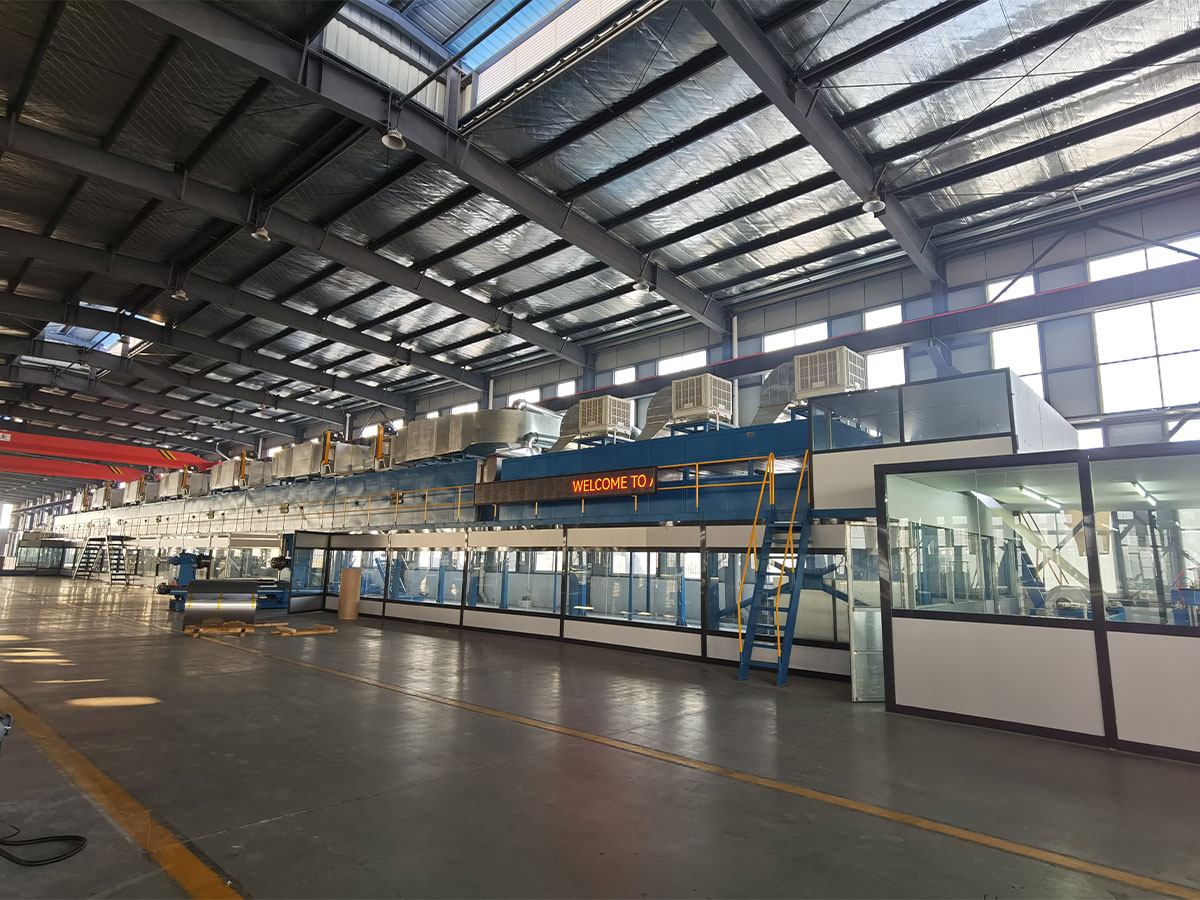
The topcoat curing oven is typically the largest and most thermally demanding piece of process equipment on a coil coating line, because topcoat formulations — particularly high-performance systems such as PVDF (polyvinylidene fluoride) or PVC plastisol — require higher peak metal temperatures and longer dwell times than primers.
Oven length on production-scale coil coating lines is typically 35 to 80 metres for the topcoat oven, allowing adequate dwell time at production line speeds. The oven is divided into multiple temperature zones — typically a heating zone, a hold zone at peak temperature, and a cooling zone — to achieve the required PMT profile without exceeding it. Thermal uniformity across the strip width is maintained by precisely balanced airflow through the oven nozzle arrays, with cross-strip temperature variation typically controlled to within plus or minus 3 degrees Celsius at the peak temperature zone.
Topcoat Quench and Strip Cooling
As with the primer section, the cured topcoat strip is immediately quenched with water after exiting the topcoat oven. Topcoat quench is particularly critical because the hot freshly cured topcoat surface is mechanically vulnerable — contact with the exit accumulator rolls, tension bridle rolls, or recoiler before adequate cooling can cause surface marking, blocking (adhesion between strip layers on the coil), or roll marking that permanently damages the appearance of the finished product.
Some line designs include an additional air cooling section after water quench to ensure the strip surface temperature is below 40 degrees Celsius before it contacts any contact rolls, particularly important for high-gloss topcoat systems where the slightest surface marking is immediately visible.
Stage 5: Backcoat Application (Where Required)
Many coil coating product specifications require a backcoat — a coating applied to the underside of the strip (the face that will be on the interior side of the finished product) in addition to the topcoat on the visible face. The backcoat serves different functions depending on the product application.
Backcoat Functions and Specifications
- Barrier against corrosion from the reverse side: In building envelope products such as wall and roof panels, the inner face of the metal is exposed to condensation, and a functional backcoat prevents corrosion that would eventually undermine the coating system on the visible face
- Protection against forming damage: A lubricated or flexible backcoat protects the strip underside during roll forming and profiling operations, reducing the risk of coating damage from tooling contact on the non-visible face
- Bonding surface for laminated products: In metal composite panel production, the backcoat is formulated to provide a specific adhesion profile for the polymer core material bonded to it in the downstream laminating process
- Aesthetics for exposed reverse faces: Products such as cassette panels used in ventilated facade systems may have the reverse face visible in the installation, requiring a backcoat finish equal in quality to the topcoat
Backcoat Application Position on the Line
The backcoat coater can be positioned at different points in the line sequence depending on the product design. On lines producing standard primer plus topcoat systems, the backcoat is commonly applied in the same pass as the primer — the backcoat coater applies coating to the underside of the strip at the same time as the primer coater applies primer to the topcoat face, and both are cured in the same primer oven pass. This arrangement minimizes the number of oven passes required but limits backcoat film weight to what can be cured in the primer oven thermal profile.
For products requiring heavier backcoat films or specialized backcoat formulations needing different cure temperatures, some line designs incorporate a dedicated backcoat coater and oven, or process the backcoat in a separate line pass.
Stage 6: Exit Section — Accumulator, Inspection, and Recoiling
After the final quench and cooling section, the fully coated strip enters the exit section of the line, where it is accumulated, inspected, and recoiled or converted to sheet.
Exit Accumulator
The exit accumulator performs the same function as the entry accumulator but in reverse: it allows the exit section (recoiler or shear and stacker) to stop briefly to change a full coil or a cut stack without requiring the process section to slow or stop. The exit accumulator stores a buffer of finished coated strip — typically 150 to 400 metres — and releases it to the exit section at the required rate while the process section continues to run.
Managing the exit accumulator correctly is particularly important from a quality standpoint, because the coated strip surface in the accumulator loop must not contact rolls or guides in a way that marks the freshly cured surface. Exit accumulator designs use wide, well-finished rolls with surface materials selected for compatibility with the coating being produced, and maintain carefully controlled strip tension to prevent catenary contact between loops.
Automatic Surface Inspection
Between the exit accumulator and the recoiler, most production-scale metal coil coating lines incorporate automatic optical surface inspection systems that scan both strip surfaces continuously for coating defects. These systems use high-resolution line scan cameras and image processing algorithms to detect defects such as:
- Coating scratches or score marks from process equipment contact
- Coater streaks or bands of uneven coating weight across the strip width
- Surface inclusions or substrate defects telegraphing through the coating
- Colour or gloss deviations from the reference standard
- Edge coating holidays or over-application
- Handling marks or roll marks from downstream accumulator rolls
Defect detection triggers an automatic marking of the defective strip location, allowing downstream operators at the recoiler or shear to exclude or downgrade the affected product. Modern inspection systems combine surface inspection with spectrophotometric colour measurement and gloss measurement to provide a complete quality record for each coil produced.
Recoiling
The coated strip is recoiled onto a mandrel at the exit recoiler, which must maintain controlled tension throughout the rewind operation to build a tight, stable coil that will not telescope or develop internal coil collapse during handling and transit. Two tension bridle roll assemblies — a tension bridle before the recoiler and the recoiler drive itself — control strip tension precisely to the target value specified for the substrate material, gauge, and coating system.
The recoiler is designed to handle the full range of coil weights produced on the line, typically up to 25 to 30 tonnes, with a coil OD (outer diameter) up to 2,000 mm on large production lines. When a coil is complete, the strip is sheared, the coil is strapped and labelled, and the new mandrel is accelerated to receive the next coil while the exit accumulator bridges the transition.
Slitting and Cut-to-Length Options
Some coil coating lines are equipped with an inline slitter or shear and stacker downstream of the recoiler, allowing the full-width coated coil to be slit into narrower strips or cut into flat sheets in the same production pass. Inline slitting is particularly valuable when downstream customers require narrower strip widths than the base coil width produced on the line, avoiding a separate slitting operation and the associated handling and quality risk of processing finished coated product through additional equipment.
Common Coating Systems Processed on Metal Coil Coating Lines
The coating system — the specific combination of primer and topcoat chemistries — is selected based on the end-use requirements of the coated product. Different applications demand different performance profiles, and the coating system must be matched to the curing conditions achievable on the specific line.
| Coating System | Typical PMT (deg C) | DFT Range (microns) | Key Performance Properties | Primary Applications |
|---|---|---|---|---|
| Polyester (PE) | 215 to 232 | 15 to 25 | Good formability, cost-effective, moderate UV resistance | Indoor applications, general building products |
| Silicon-Modified Polyester (SMP) | 220 to 240 | 20 to 25 | Improved UV and heat resistance vs. standard PE | Roofing, cladding in moderate climates |
| High-Durability Polyester (HDP) | 220 to 245 | 25 to 35 | Enhanced chalking resistance, extended colour retention | Architectural facade systems, premium roofing |
| PVDF (Polyvinylidene Fluoride) | 240 to 260 | 25 to 35 | Outstanding UV resistance, colour retention, chemical resistance | High-end architectural, coastal and aggressive environments |
| PVC Plastisol | 200 to 215 | 100 to 200 | Excellent formability, high film build, good impact resistance | Profiled roofing sheets, agricultural buildings |
| Polyurethane (PU) | 220 to 245 | 25 to 50 | High flexibility, good mar resistance, glossy finish options | Appliance panels, automotive components |
| Epoxy Primer | 210 to 230 | 5 to 10 | Excellent corrosion resistance, strong adhesion to metal | Primer layer under most topcoat systems |
| Source: European Coil Coating Association (ECCA) Technical Publications; National Coil Coating Association (NCCA) Industry Data; general coil coating industry reference values | ||||
Quality Control Checkpoints Throughout the Process
A well-operated metal coil coating line integrates quality monitoring at multiple points in the process flow, rather than relying solely on end-of-line inspection of the finished coil. Catching process deviations early — before they are locked in by the curing oven — allows corrective action at the coater level rather than producing a large quantity of off-specification material that must be downgraded or scrapped.
Pre-Treatment Quality Monitoring
- Alkaline cleaner bath concentration and temperature: checked at minimum every two hours during production, or monitored continuously by inline conductivity sensors
- Rinse water conductivity: monitored continuously to detect cleaner carryover into the rinse stages that would contaminate the conversion coating bath
- Conversion coating bath concentration and pH: checked at specified intervals and adjusted to maintain target conversion coating weight on the strip surface
- Conversion coating weight: periodically verified on strip samples using X-ray fluorescence measurement, targeting typically 10 to 40 mg/m2 for chromate-free systems
Coating Application Quality Monitoring
- Coating viscosity and temperature in the coating pan: monitored and controlled to maintain consistent application weight through the production run
- Wet film thickness: checked at coater startup and after any speed or roll setting change using wet film gauge measurement on samples taken directly from the coater
- Dry film thickness: measured on cured samples using magnetic induction gauge (for coatings on steel) or eddy current gauge (for coatings on aluminum), and by the inline X-ray or optical gauges described in the exit section
- Peak metal temperature: monitored continuously using strip thermocouples at the oven exit and validated periodically with datalogging temperature profiles run through the oven on calibrated carriers
Finished Coating Quality Tests
At the exit of the line, samples are taken from each production coil for laboratory testing against the applicable coating specification:
- T-bend adhesion test: The coated panel is bent 180 degrees over itself and the degree of coating cracking or delamination rated against a pass/fail criterion; a 0T or 1T pass indicates excellent coating flexibility and adhesion
- Cross-hatch adhesion test: Per ISO 2409, a grid pattern of cuts is made through the coating and a standardized tape pull applied; any detachment of the coating indicates an adhesion failure
- Pencil hardness: Evaluated per ASTM D3363, confirming that the cured coating has achieved the specified hardness indicative of full cure
- Reverse impact resistance: Assessed using a falling weight impact on the reverse side of the panel, checking for coating delamination on the impact face
- Colour measurement: Spectrophotometric measurement against the master colour standard, with tolerances typically expressed in CIE Delta E units (allowable deviation typically Delta E less than 0.5 to 1.0 for tight-tolerance products)
- Salt spray corrosion resistance: Periodic accelerated corrosion testing per ISO 9227 to validate that the coating system is providing the specified corrosion protection (Source: ISO 9227:2022, Corrosion Tests in Artificial Atmospheres)
Process Flow Summary: From Bare Coil to Finished Pre-Painted Product
The complete process flow through a standard metal coil coating line can be summarized in sequential order as follows:
- Coil loading and strip threading: Bare metal coil loaded onto payoff reel; strip threaded through the line and joined to the running strip tail
- Strip flattening: Coil set removed by leveler or flattener rolls to achieve flat strip geometry required for consistent coating application
- Entry accumulator filling: Strip loop built in entry accumulator during initial threading and during normal production when entry section runs faster than process section
- Alkaline cleaning: Surface oils, lubricants, and oxides removed in heated alkaline spray or immersion cleaning system
- Rinse stages: Residual cleaner removed in multiple water rinse stages; final rinse with demineralized water
- Conversion coating: Chemical reaction between treatment solution and metal surface creates inorganic adhesion-promoting corrosion-resistant layer
- Drying: Residual rinse water removed in drying oven or air knife system before coating application
- Primer application: Roll coater applies liquid primer to topcoat face; simultaneous backcoat application on reverse face on many line designs
- Primer curing oven: Strip heated to target PMT (215 to 232 degrees Celsius typical) to fully cure primer film
- Post-primer quench: Water quench cools strip to below 50 degrees Celsius before topcoat application
- Topcoat application: Roll coater applies liquid topcoat at the specified film weight (15 to 60 microns DFT)
- Topcoat curing oven: Strip heated to topcoat-specific PMT (220 to 260 degrees Celsius depending on coating chemistry)
- Post-topcoat quench and cooling: Water quench followed by air cooling to below 40 degrees Celsius before contact rolls
- Exit accumulator: Coated strip buffered to allow recoiler changeover without stopping process section
- Surface inspection: Automated optical inspection of both strip surfaces for coating defects; colour and gloss measurement
- Recoiling and labelling: Finished coated strip wound onto exit coil; coil weight, dimensions, and quality data recorded against coil identity
- Optional slitting or cut-to-length: Coated coil slit to width or cut to sheet dimensions as required by customer specification
Selecting the Right Metal Coil Coating Line Configuration
Metal coil coating line specifications must be matched to the specific production requirements of the operator — substrate types, strip widths, coating systems, production volumes, and product mix all influence the correct line configuration. Key specification decisions include:
Line Speed and Oven Length
Line speed and oven length are linked: a faster line requires a longer oven to achieve the same strip dwell time at peak metal temperature. Production-scale coil coating lines targeting output rates of 80 to 150 m/min require total processing section oven lengths (primer plus topcoat) of 60 to 120 metres or more. Smaller lines designed for flexible production of short runs at lower speeds can use shorter ovens. Matching oven length and speed to the coating systems intended for production is the central design decision in line specification.
Strip Width and Substrate Capability
Production lines are designed around a maximum strip width, typically from 600 mm to 2,000 mm depending on the target market. The coater head, oven nozzle arrays, quench headers, and accumulator rolls must all be designed for the maximum strip width while maintaining performance uniformity across the full width. Lines designed to process both steel and aluminum substrates require consideration of the different thermal properties, forming requirements, and surface treatment requirements of each material.
Automation and Control System Integration
Modern coil coating lines integrate process control, quality data collection, coil tracking, and production management into a unified automation platform. Level 1 control (PLC-based process control) manages individual drives, coaters, and oven zones. Level 2 control (process management system) integrates quality data, production scheduling, and recipe management for different product specifications. Level 3 connectivity (ERP integration) links the line to the plant's production planning and quality management systems. The degree of automation specified directly affects both the line's ability to maintain consistent quality across long production runs and the operator skill level required for effective production management.
For manufacturers evaluating new coil coating capacity or upgrading existing lines, working with a supplier experienced in complete turnkey Metal Coil Coating Line design and delivery — capable of integrating all process sections from entry to exit into a coherent, well-optimized production system — is the most reliable route to a line that meets both current production requirements and future product development needs.